Edusphere – Phase 2: Assumption Testing (Part 1)
Team Members
Maria, Sarah, Kristine, Varsha, Alex, Kevin
Identifying Our Riskiest Assumptions
After revisiting our Assumption Map from David Bland’s lecture, we prioritized the assumptions that, if proven wrong, would fundamentally challenge Edusphere’s value proposition and business model. We focused on product desirability and willingness to pay, which are key risks for our tutoring platform as we prepare to scale.
Our top three riskiest assumptions:
- Tutors are seeking help creating, managing, and sharing quality learning content.
If untrue, our “content hub” core feature loses relevance. - Students still need human tutoring for accountability, clarification, and motivation—even when digital content is available.
If false, our tutor-centered platform could be replaced by self-paced learning products like Khan Academy. - Tutors are willing to pay for a platform that saves time and improves tutoring quality.
If untrue, our monetization model breaks.
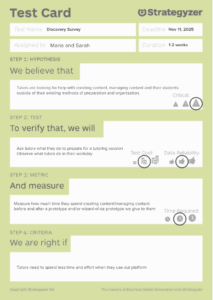
Test Card 1: Discovery Survey
Hypothesis:
We believe that tutors are looking for help creating content, managing content, and teaching students outside their existing prep methods.
Test:
Interview tutors about how they prepare for sessions and observe their workflow to understand time and effort distribution.
Metrics:
Track time spent preparing content versus delivering tutoring; identify recurring pain points in prep. Then compare time spent with a wizard-of-oz prototype of our product.
Success Criteria:
We are right if tutors report high effort and frustration creating lesson materials and express a desire for a streamlined platform.
Rationale:
This validates the problem-solution fit for our educator dashboard and content hub themes.
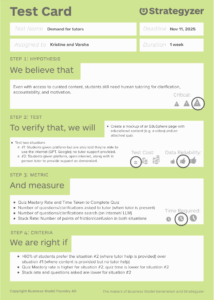
Test Card 2: Demand for Tutors
Hypothesis:
We believe that even with access to curated content, students still need human tutoring for accountability and clarification.
Test:
Prototype an Edusphere tutor-matching interface with sample session pages; compare student interest and satisfaction with self-study versus tutor-supported tasks.
Metrics:
- Quiz mastery rate and completion time
- Student self-reported motivation (Likert scale)
- Tutor sign-ups for demo sessions
Success Criteria:
We are right if students in the tutor-assisted condition complete more tasks and report higher motivation.
Rationale:
This experiment directly tests the necessity of human-in-the-loop tutoring for learning outcomes.
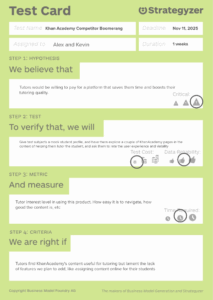
Test Card 3: Khan Academy Competitor “Boomerang”
Hypothesis:
We believe that tutors would pay for a platform that saves them time and improves session quality.
Test:
Run a comparative pricing and usability test: show tutors Edusphere vs. Khan Academy-style free tools, then gauge willingness to pay for Edusphere’s premium version.
Metrics:
- Percentage of tutors indicating willingness to pay ≥ $10/month
- Qualitative feedback on perceived value and feature utility
- Time-on-task and navigation ease scores
Success Criteria:
We are right if ≥ 30% of tutors express willingness to pay for Edusphere and rate usability above 7/10.
Rationale:
This assesses market viability and our pricing hypothesis.
Reflection on Risk
These assumptions represent our desirability and viability risks:
- If tutors aren’t seeking content tools → we must pivot from B2B tools to student-facing learning management.
- If students don’t need tutors → our service differentiation collapses.
- If tutors won’t pay → our business model is unsustainable.
By running these three experiments, we can quickly validate (or refute) our most dangerous assumptions before investing heavily in full-scale development. Each test produces quantitative and qualitative signals to guide pivot or persevere decisions.