What is your project concept?
Orbit is a social reminder app that helps users maintain and build social relationships through a two-pronged approach: data visualization for people to reflect on their connections and reminders/challenges to ensure they stay connected to the people in their network.
Why is your value proposition statement correct (e.g., the research says so!)?
The vast majority of users we have spoken to (three rounds of user researching totaling twenty interviews) have appreciated the app concept. Missed texts, unreturned phone calls, rain-checks that are never cashed in—our target users have incredibly busy and fast-paced lives, and it is easy to let relationships slip through the cracks no matter how important they might be to them. They want to be more active in their relationships by calling first, initiating the long-postponed lunch plans, or remembering the birthday of every person in their life. Our users might forget what’s going on in someone else’s life—a crazy interview process or new puppy—and need a cue to remember without letting their friend know they’ve forgotten. They might see something during the day and want to remember to mention it the next time they see someone (which they usually never do). There may be a person they’ve been meaning to get to know more but can’t get themselves to send the first text.
These stories were gleaned from users of all backgrounds: high school students and young professionals, college students and people who went to trade school, most importantly not just Stanford students! A lot of our target users love visual cues that the orbit map offers (both because of the aesthetic intrigue and the information it gives), though it was more of a nice-to-have compared to the reminders. The map is more controversial, which will be discussed later in our assumptions testing. Almost all the users we spoke to appreciate the reminder system, though the exact manifestation of those reminders has yet to be crystalized. Some users appreciated the option to customize, but we have to explore more how often users want to be reminded, how often they like to message people, and what staying connected/in touch means to them.
What motivated your choices for the MVP?
More so than the user story mapping, our participatory roadmaps decided the direction and feature list for our minimum viable product. The most crucial feature was the reminder/challenge aspect, which is obvious since it is the best way to remember to stay connected. The visual map was a nice-to-have for some users, but a couple users really valued it as visual people. There were a couple users concerned about the visual map. To them, the drifting mechanism would cause negative emotions like anxiety, and it would cause actions in relationships to feel transactional. This is a crucial perspective we haven’t heard, and we will be sure to further hone the visualization idea with more assumption testing. Overall, adding people, push notifications, and the visual map were the features most favored for our MVP. We decided to keep the visual map since it is our main differentiator compared to competitors.
What is the goal of the project; how are users’ lives changed by your product?
The goal of Orbit is to help users maintain and build social relationships. We’re not asking users to slow down, we’re meeting them where they are at by creating actionable reminders. Our goal is to help them be more intentional and reflective in their relationships. Ideally, they have more connections and deeper relationships by using our product.
What assumptions are you still worried about?
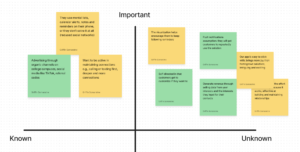
We are still worried about our three riskiest assumptions, which are featured at the bottom of the blog post in Experience Prototype Testing. There are two main mental models those assumptions are addressing: how people conceptualize staying connected/in touch and how people conceptualize their relationships/social networks. We are assuming that people will do the challenges, that the challenges will work (make them feel more connected), and that the visual map will encourage people to reach out to people in their life and reflect on their relationships. The second assumption extends outside of the app as well—do the challenges make the receiving person feel more connected to our user? It is difficult to test this in an experience prototype, however, without cheapening the interaction between user and connection.
What experience prototypes have we done, and why? How did they turn out?
We did our first experience prototype with three users because the visual map is the least resolved from a user research perspective—we haven’t really asked people how they visualize their relationships. While one mentioned that it would give them a sense of urgency, two of the users were opposed to the drifting mechanism in our map (in which a person drifts away if the user doesn’t complete suggested challenges or reminders). They mentioned that the map’s premise would make friendships seem transactional—literally since an action in a friendship decreases the distance. They thought that was too simplified of a visualization and assumes there’s a one-size fits all approach to every relationship (one action might not be as effective in every friendship). They suggested that the drifting apart is self-determined, like after you hang out, you log how much closer or farther apart you feel to that person. The map becomes more of a reflective opportunity than another reminder to do something.
Are there experience prototypes that you may need to build next?
Our two reminder experience prototypes to test whether people do them and whether they work.
How viable is our product as far as we know, with the assumptions we currently have and the experience prototypes we have done?
The reminder aspect is viable, but the visual map requires more honing.
What advice do you want from your reviewers?
Our visual map seems to be the least resolved from a user research perspective. We at least know users like reminders even if we don’t know what the default should be and how they would want to customize them. Should we abandon the visual map and focus on a reminder app that is simply branded well with exciting iconography? We would be turning away from our only differentiator. It seems like users valued the concepts of the reminders and visual map, but the exact execution could turn them away.
Value proposition statement mad libs:
Orbit helps young adults who want to maintain their social connections by reminding them to reach out and rewarding them with a social map that grows closer as their relationships progress unlike simple planners such as Notion or pen and paper.
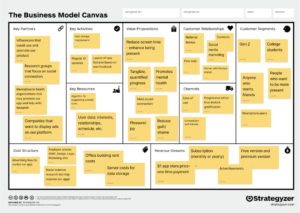
Business Model Canvas:
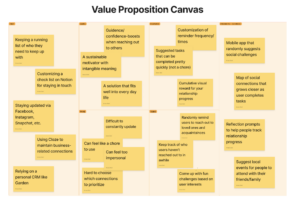
Value Proposition Canvas:
Comparative Research:

Participatory Roadmap:


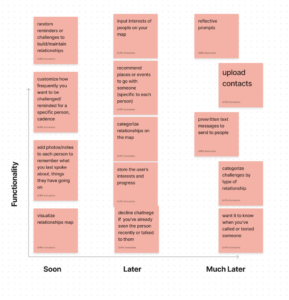
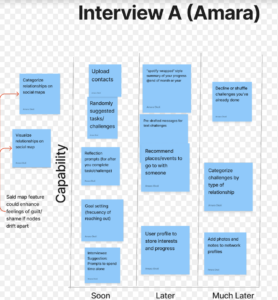

User Story Mapping (MVP indicated in blue):

Assumptions Map:
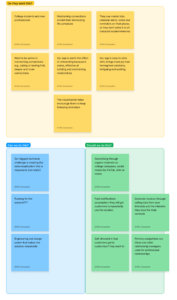
Experience Prototype Testing:
We have a more detailed description of our prototypes (less tailored to the testing card format) here.
Test Card 1:
- We believe that: Viewing the visualization will encourage people to contact the people in their life
- To verify that, we will: have people draw a map of their social connections with themselves in the center. The distance between them and their connections should reflect the level of closeness that they have (distant relationships should be further away from the center). Ask them to think out loud, ask how they feel about the process and why they chose the placements that they did. 2-3 days later, have them annotate the map based on any changes they’ve experienced in their relationships. Ask them how they feel about the process and why they chose the annotations that they did.
- And measure: how the visualization of their social relationships changes their perspective and makes them more aware of who they haven’t kept up with.
- We are right if: people value the social map and the drifting mechanism, if they want to reach out to people that drift on their map.
Learning Card 1:
- We believed that: viewing the visualization would encourage people to contact the people in their life
- We observed: people drawing a map of their social connections with themselves in the center while they thought out loud.
- From that we learned: that the underlying mechanism of the map (drifting closer or farther depending on challenges) creates negative feelings, creates a transactional mindset, and is an oversimplified view of friendships.
- Therefore we will: conduct more user research interviews to capture our target users’ mental models of their social relationships.
Test Card 2:
- We believe that: people will actually do the challenges that we suggest.
- To verify that, we will: conduct this A/B test style to compare differences between people that get the social map visualization and those that don’t.
- Group A: have people make a map of their social relationships and send it to us. Send random reminders to these people for 3 days over text that encourage them to reach out to people on the map. If they confirm that they did a challenge by sending a photo or screenshot, then we move the corresponding social connection closer to the center of the map. At the end of the 3 days, send them the updated map. Ask them how they feel about the changes in the visualization.
- Group B: same procedure as group A except without any of the social mapping steps. Simply send the text reminders and verify that they completed each challenge.
- And measure: the number of tasks people do and the motivation they feel upon receiving and completing a task
- We are right if: every user does at least 50% of the challenges they receive.
Test Card 3:
- We believe that: people will feel more connected and closer to the people in their network after doing the challenges.
- To verify that, we will: conduct a social experiment-inspired prototype in which we ask strangers we encounter on campus to text, call, or email someone they haven’t spoken to in a while. We will first ask them how they think about that person and how they feel about that—also why they haven’t spoken recently. We will ask them to share a message with that person that they’ve been thinking of them and to include anything else they want to say. We will then ask them how they felt about the process.
- And measure: their emotions following the social experiment and their concept of their relationship
- We are right if: at least half of the users note positive feelings following the experiment.