
Team Members: Diego Sanchez Tirado, Felicia Yan, Isaac Were, Itai Reingold-Nutman, Janus Tsen, Victor Ahona, Carolyn Lee
Norms
- Be vocal and communicative about issues upfront when they arise
- Be flexible about modes of collaboration (online or in-person) depending on what an assignment will take
- Hold each other accountable, ok to @ ping if work is missing
- Set goals for each other as a team to set expectations for scope of individual work and divide work evenly
- Be transparent about schedules, availabilities, and conflicts
New Questions
General questions
- Grand Tour: I’d like you to walk me through your day yesterday. I’d like you to pick a specific day, and walk me through your day starting from when your work day started.
- What was a specific positive moment of your day or your week?
- Who was involved? What made it positive? How did you feel?
- When things are going smoothly at work, what allows this to happen?
- Thinking about your work this past week or month, what was a challenging part of it? What’s another?
- When was the last time that happened? How did it play out?
- What did you do to make it easier for yourself? (e.g. process, tool, workaround)
- How did that make you feel?
- How often does this happen?
- What do the internal processes look like?
- What distinguishes your line of business/sector from adjacent fields or professions?
Inter-team collaboration
- Tell me about a recent time you needed to coordinate with another team. How did it go?
- How do you find out what other teams are working on or changing?
- Who was involved?
- Tell me about the last time you found out that another team’s work affected yours. How did you find out? What did you do?
Stakeholder management
- Tell me about a time you and your team weren’t on the same page.
- How did you notice the misalignment?
- How do decisions get made and recorded?
- How was it resolved? Who was involved?
- Tell me about a time you had to get buy-in for something you were working on.
- Tell me about a time when getting buy-in went well and when it didn’t. What was different?
Tools and skills
- Tell me about a time when you had to learn how to do something new.
- What was it? Why did you have to learn it?
- What tools do you use in a typical week? Can you show me how you use one?
- Tell me about the last time you used an AI tool at work. What did you do with the output?
- What do you not trust AI to do? Why?
- Tell me about the last time you used an AI tool at work. What did you do with the output?
- Where does important information about your product live? Tell me about a time you couldn’t find something you needed.
Understanding customers and users/discovery
- Tell me about the last time you needed to learn something about your users or customers. How did that information reach you?
- Besides talking to users directly, how does customer information reach you? (support tickets, sales calls, surveys, analytics)
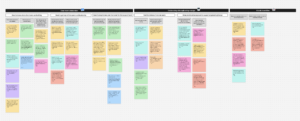
Affinity Map
Team Figma board:
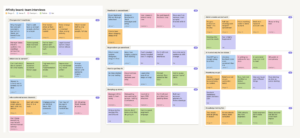
More themes:
AI Pass
What did it catch that you missed?
It was able to connect stories we had filed separately. It also saw that we had some details that we had skipped, like a one line SQL change that turned into a long cross-team thread, and a PM being the only tester because there was no QA team.
What did it flatten into something generic?
It flattened a couple things, like someone’s workaround into “PMs heavily utilize Notion and AI tools” which flattened the actual pain that they were facing, which was that Notion is out of date. Another thing that it flattened was that a PM’s general comments of their own design background, which it generalized.
Did it assert anything that isn’t in the transcripts?
Gemini said research was “vetoed by leadership,” but the PM only said they “got vetoed every single time” and never named leadership. It also presented one of our own interview questions, about owning the product without authority, as something a PM told us.
Long List
| # | Problem | People | Already hacking around it? | Quote |
|---|---|---|---|---|
| 1 | PMs have to win buy-in through influence, not authority. Engineers and partner teams want proof that something is worth doing. | 5 | Yes: they pull stakeholders into writing the PRD, back the case with research and prototypes, and frame requests around the other team’s goals | “the most arduous pain point is just getting people to see the value of something, as opposed to them thinking it’s just a feature or a request that has come out of thin air.” (P1) |
| 2 | New PMs ramp up with little structure or mentorship, sometimes in an unfamiliar field | 5 | Yes: AI-generated outlines, self-made roadmaps, reading GitHub and Discord, home-made glossaries | “this is like my first time writing a PRD, and like with no mentorship, so I did like kind of turn to some AI tools and ask it to kind of give me at least like a structure that could follow.” (P3) |
| 3 | Design, engineering, and the PRD drift apart, and the gap shows up late, sometimes after sign-off | 4 | Partly, and after the fact: more check-ins, renegotiating scope, escalating | “kind of hard to translate, like, a Figma file and, like, a technical blueprint and, like, PRD, like, to always make sure there’s, like, a one-to-one match, like, all three.” (P5) |
| 4 | PMs don’t get to talk to real users directly; needs arrive secondhand and research gets skipped | 4 | Yes: watching session replays, building ties with account teams to get onto calls, using AI to scrape Discord and GitHub | “I don’t get to speak to them. I get to speak to whoever relayed that to me, and then get their version of what they think the customer wants. So it’s like a game of telephone almost there.” (P1) |
| 5 | Testing falls on the PM when there’s no QA team or tooling | 4 | Yes: clicking through flows by hand, fake patient databases, rebuilding Google Sheets systems | “My company also doesn’t have any QA. So then that falls on the product… is going in and, like, testing it out, like, at least, like, the front-end, like, user flows.” (P5) |
| 6 | Too many conversations: back-to-back meetings and dozens of Slack threads | 4 | Partly: working from message replies, AI recap emails | “you might have 20 to 30 active Slack threads going on that could be about just different stuff” (P2) |
| 7 | AI output can’t be trusted for high-stakes writing or specialized terms | 4 | Yes: writing critical docs by hand, checking every output | “if I write something that’s really information sparse, which is kind of the default for an LLM. Even if I get that information out really quickly, it’ll take someone so long to read it they won’t bother, and so no one knows what’s going on.” (P2) |
| 8 | Docs go stale, and no one source says which one is current | 3 | Yes: booking a meeting with the doc’s owner, trusting Linear and Slack over Notion | “especially when I try to learn about other teams, it’s like impossible to like figure out what’s like the most recent doc.” (P4) |
| 9 | PMs can’t see what other teams are launching, so unrelated launches break their work | 3 | Mostly not: over-communicating in Slack | “oh my god, I wish I could have, like, a snapshot into, like, what other teams are, like, up to.” (P5) |
| 10 | PMs can’t speak engineering’s language or read the code | 3 | Yes: having engineers check specs, using AI to translate code | “maybe something that’s that would be useful is like better internal tools that would help me understand the code base.” (P4) |
TAM
Targeting the market of product managers globally, the TAM is $4.95-8.01B. Sources based on the number of Linkedin profiles with product management-related titles estimate that there are 1,618,000-2,617,000 product managers globally [1][2]. The median cost of enterprise software per employee per year based on company size is $2,650 for startups, $2,720 for mid-market, and $3,420 for enterprise. [3][4]. Using these figures as the software spend attributed to a PM seat and scaling by approximate share of global PMs based on company size, the TAM equation is 1,618,000-2,617,000 * (0.5 * $3,420 + 0.35 * $2,720 + 0.15 * $2,650) = $4.95-8.01B. This is similar, though slightly more conservative, than secondary source estimates of the global product management software market size to be about $8-10B in 2025. [5][6]
Sources:
- Product Focus Product Managers Across the World https://www.productfocus.com/product-management-resources/infographics/product-managers-across-the-world/
- Product Management Institute, 2025
https://www.pmi.org/-/media/pmi/documents/public/pdf/learning/thought-leadership/pmiproject–product-mgmt-report20250520.pdf?rev=8f6f9f5f216544838c856e9fc595ab95 - Product Focus, Top 10 Product Management Tools 2020 https://www.productfocus.com/wp/wp-content/uploads/2020/02/Top-10-Tools.pdf
- Vendor Benchmark, 2026 https://vendorbenchmark.com/guides/saas-pricing-benchmark-by-company-size
- Dataintelo, 2025 https://dataintelo.com/report/global-product-management-software-market?utm_source=chatgpt.com
- 6WResearch, 2025 https://www.6wresearch.com/market-takeaways-view/how-big-is-the-product-management-software-market?utm_source=chatgpt.com
Reflection
We found that the biggest change from our cold and round 2 interviews was the use of more story-driven questions, which allowed us to gain deeper insights into PMs pain points. In initial interviews, we tended to accept interviewees’ responses at face-value and move on to the next question on our list. By explicitly following up with questions such as “can you tell me a time when X happened?” instead of moving on when an interviewee gave a general response, we were able to uncover more specific examples that would have otherwise gone unnoticed.
This experience connects with Torres’ idea that participants’ stories will be filled with specifics and generalities, so the interviewer must steer them towards concrete details and past experiences.
