
Team 3: Alahji Barry, Elyse Cornwall, Kaitlin Peng, Anooshree Sengupta, Cecilia Wu
Problem Domain
Our team is invested in seeking a solution for unconfident decision making. Oftentimes the process could be inefficient or cause overthinking of previous decisions. It’s these sometimes problematic feelings and behaviors that affect most people’s day-to-day life. We seek to resolve that hole by designing a solution that would allow users to prioritize their needs and as a result feel convinced that their decision was correct.
Baseline Study
Audience
Our target audience for the baseline study was college students and recent graduates who have trouble with decision making, specifically those who find themselves making decisions slowly or not feeling confident about the decisions they make. We were also looking to recruit one “power user”—someone who makes decisions easily.
Selecting Participants
We first recruited possible participants through this screener, then conducted a pre-study interview to confirm the participants fit our target audience and were articulate in sharing their thoughts. We were also looking for information on how the participants approach decision making and possible leads into what causes people to find decision making easy/hard. See here for the full interview script.
Protocol
For our 5 day diary study, participants were asked to log 3-5 decisions they made each day with details about what they were deciding, how much time they took, and what they decided to do. Then, every night, they were asked to complete nightly reflection questions.
More details about the protocol and nightly reflection questions can be found in this document.
Synthesis
For more detailed explanations on our synthesis and key insights, see the sections titled “Unpacking Our Data” and “Models” in our 5A blog post.
Here are some of the techniques our team used to synthesize our data:
- Affinity Mapping

Affinity Mapping Done in Class 
Affinity Map Close-Up. Bottom left: low-stakes decisions. Top right: confidence. - Frequency Grouping
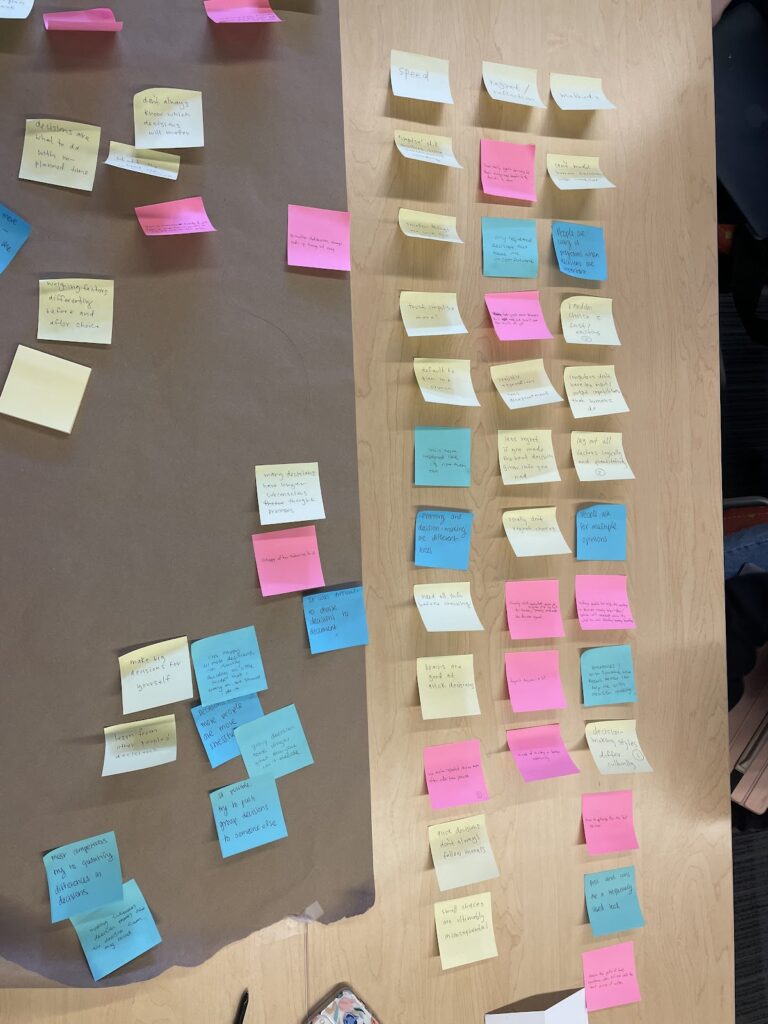
Frequency Grouping Done in Class 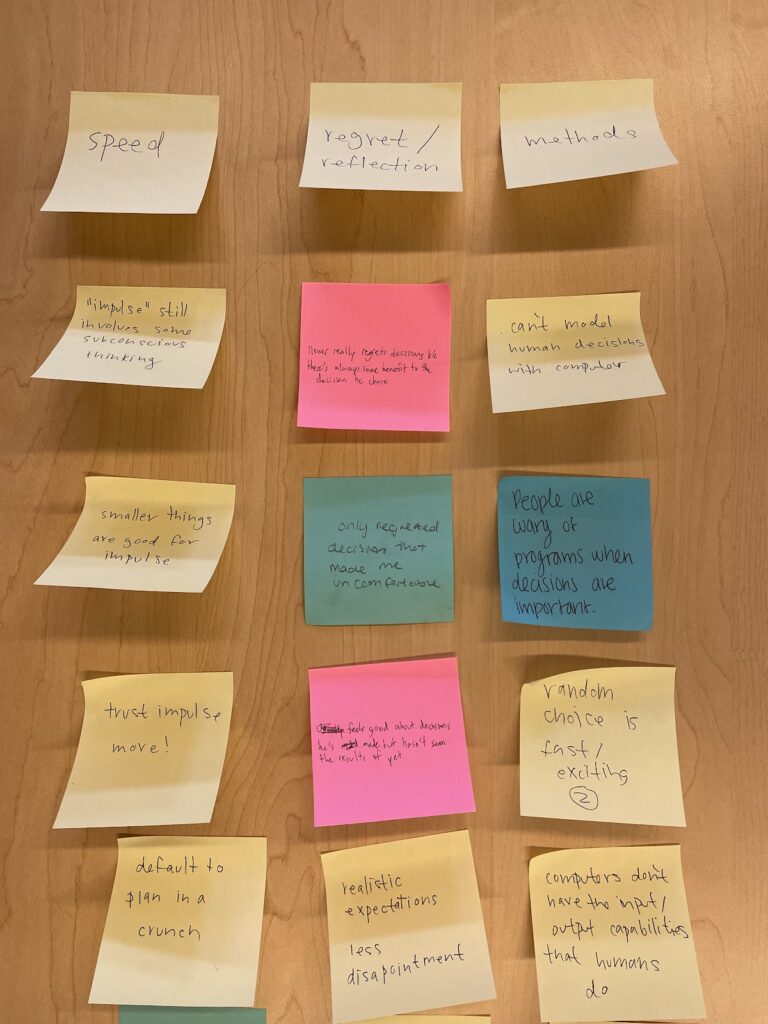
Some Themes from Frequency Grouping: Speed, Regret/Reflection, and Methods - Matrix mapping

Three Matrices to Represent Types of Decisions - Connection Circle
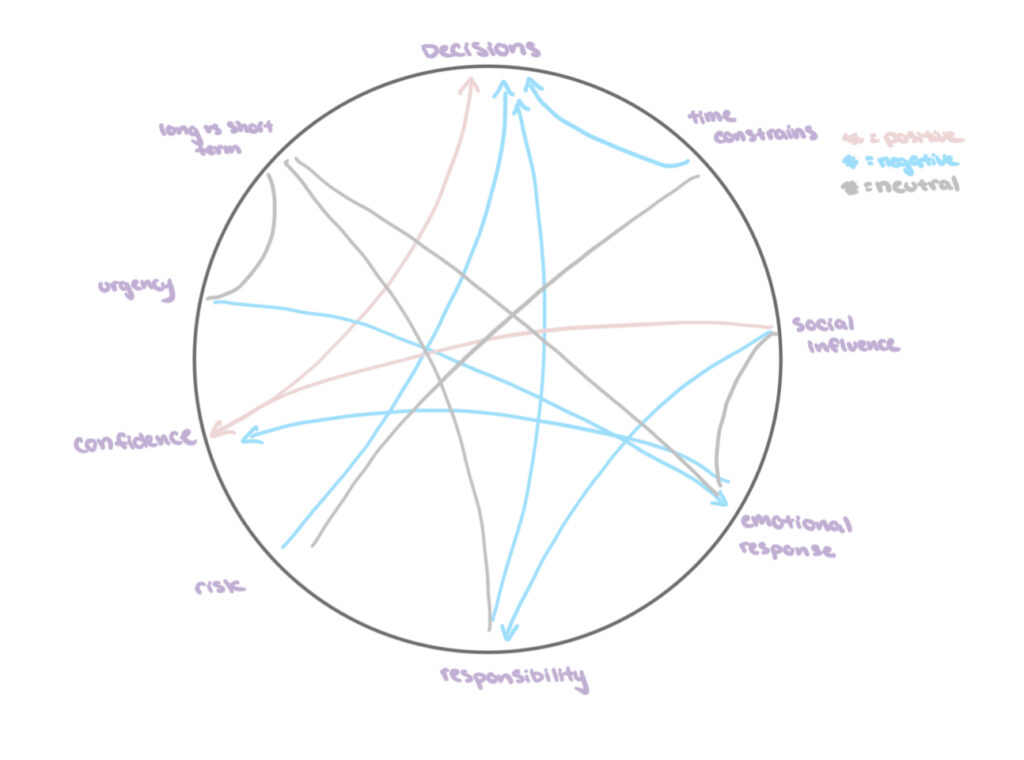
Connection circle with factors that could influence one’s decision making process
Key Insights
Here is a summary of the key insights we found from our synthesis:
- Participants’ pain points in the decision making process fell into three main categories:
- Making fast decisions
- Making “the right” decision
- Feeling confident in their decisions
- Participant data clustered around issues of confidence and importance
- A category with high frequency was “Regret/Reflection”
Moving forward
Looking at our insights, we decided to shift our focus more towards helping users feel more confident about their decisions, make decisions easier, and feel less regret.
Comparative Research & Analysis
For more details, check out our detailed Comparative Analysis here.
Most of the current competitors are unknown, and the apps and websites get little to no traction. We selected 10 of the most popular ones, and that addressed a diverse type of needs in decision making for a more holistic review.
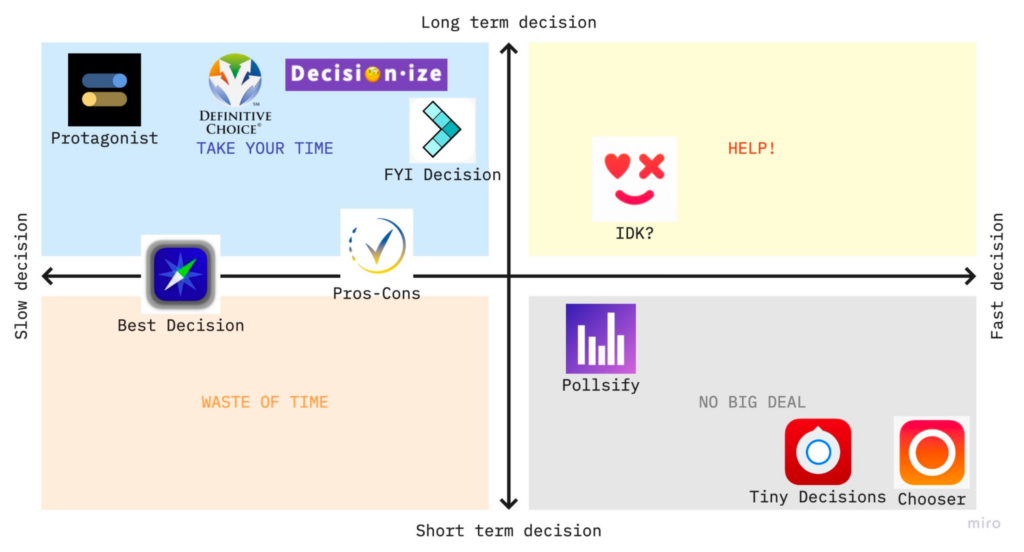
Let’s separate the website or app’s advantages and weaknesses into slow and fast decisions. Applications in the fast decisions category succeeded in satisfying people’s need to make quick and urgent decisions by rapidly selecting random input options. For example, the Chooser App allows users to just place the participant’s finger onto the screen, and then the app immediately chooses someone.




Screenshots from the Chooser App
Many of the existing slow decision solutions enabled users to specify the exact factors that would influence their decisions. This will allow them to weigh the pros and cons, like in the Definitive Choice App, which provides an intuitive way to weigh decision criteria. However, the extreme option of either having full freedom (slow decision solutions) or by chance (fast decision solutions) also highlights the weakness of existing remedies. Due to either lack of guidance or overwhelming options, the current options have not met the users’ demands. The details of specifically how apps accomplish their goal with their design for their audience is discussed in the Comparative Analysis link.
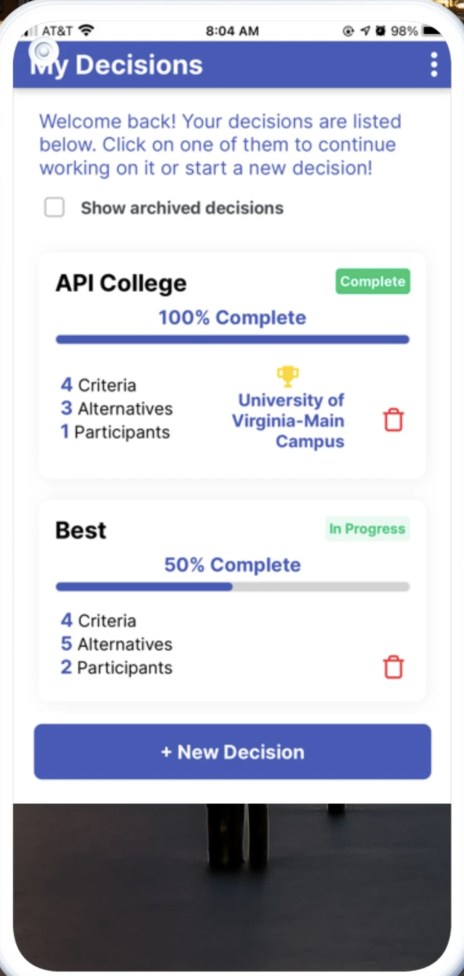
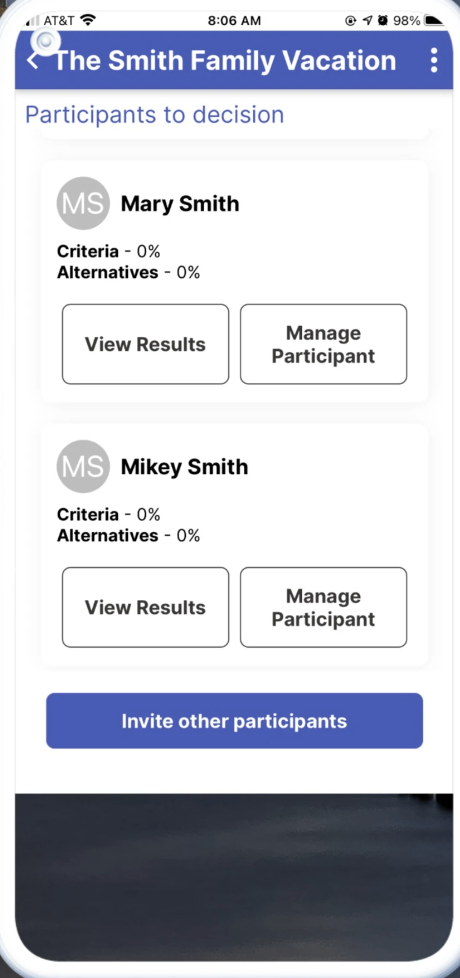
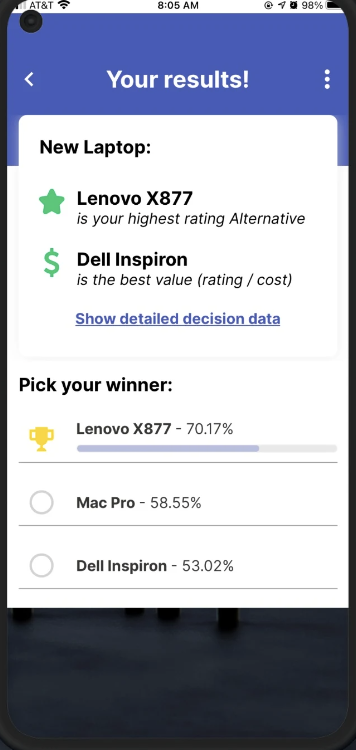
Screenshots from the Definitive Choice App
We created a matrix that maps exactly where the current solutions lie. We found that most of them that are long term are associated with solutions that take longer periods of time. In contrast, short-term decisions are often associated with quick random selections. These are two opposing sides, leaving the middle in between open. Therefore, we hope to position ourselves where users can use the app for all types of decisions. We strive to build confidence in our users after they have decided to increase their satisfaction level and, thus, reduce their regrets.
Literature Review
We also conducted a literature review, where we explored 5 different areas under decision making and compiled our main insights into the 3 categories below. For a more in depth review, see this blog post.
Confidence
In two papers (1, 2), we found that people’s confidence in decision making is subjective; when people feel they don’t know the “right” answer to a decision, their confidence deteriorates and they will try to gather more information. We also found that when people make important decisions, they feel more confident after manually aggregating data about their choices.
Time
Despite it being optimal to spend less time on decisions when choices are similar, people tend to spend significantly more time on them. We reviewed two papers about how people can make decisions faster, but we found somewhat contradicting results: (1) suggests that in intense work environments, rationality and extensive analysis speeds the process, but (2) argues that more automatic decisions are more helpful. Finally, under time pressure, people tend to default to familiar decisions.
Training
Three of the papers we reviewed (1, 2, 3) suggest evidence that teaching/training people to make better decisions promotes more effective decision making.
Personas & Journey Maps
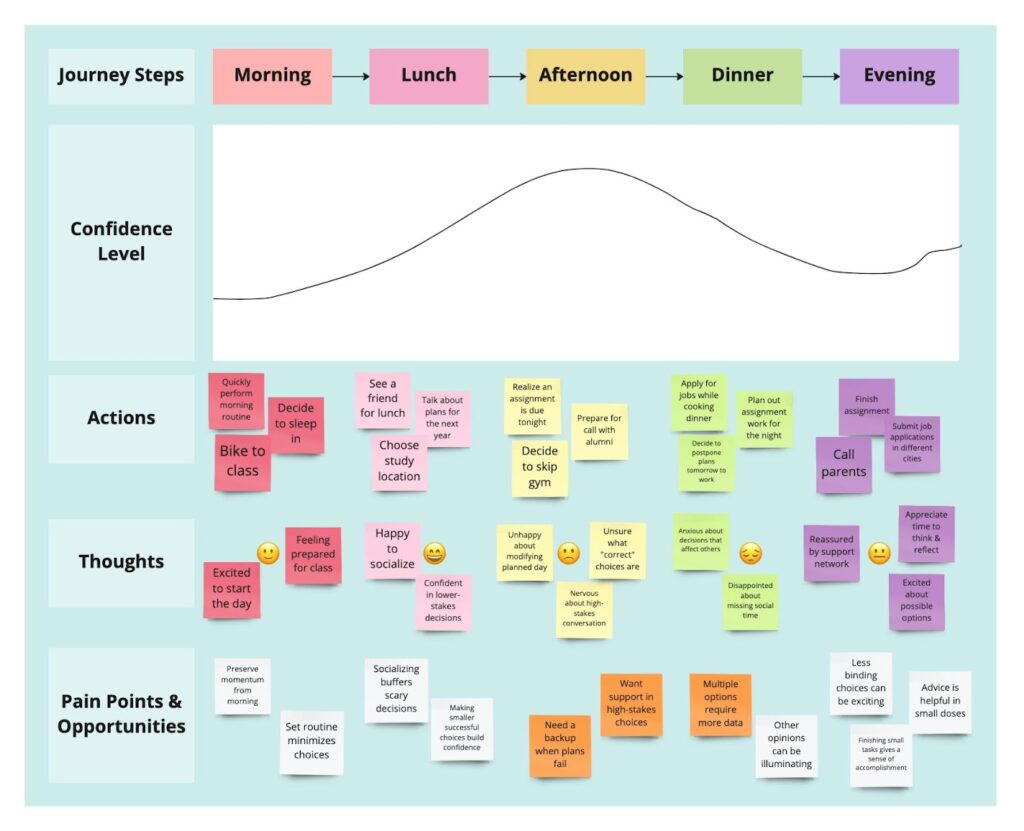
For our first persona, we wanted to deep dive into the mindset of someone preparing to leave college:
This journey map catalogs a single day in the life of “Anne.” We chose to track her confidence level, with the lower end indicating regret and the higher end indicating pride and comfort. Pain points are in orange, and opportunities are in white.
For our second persona, we wanted to understand the feelings of someone navigating big and amorphous decisions. Walt recently graduated from college and is experiencing a huge lifestyle change.
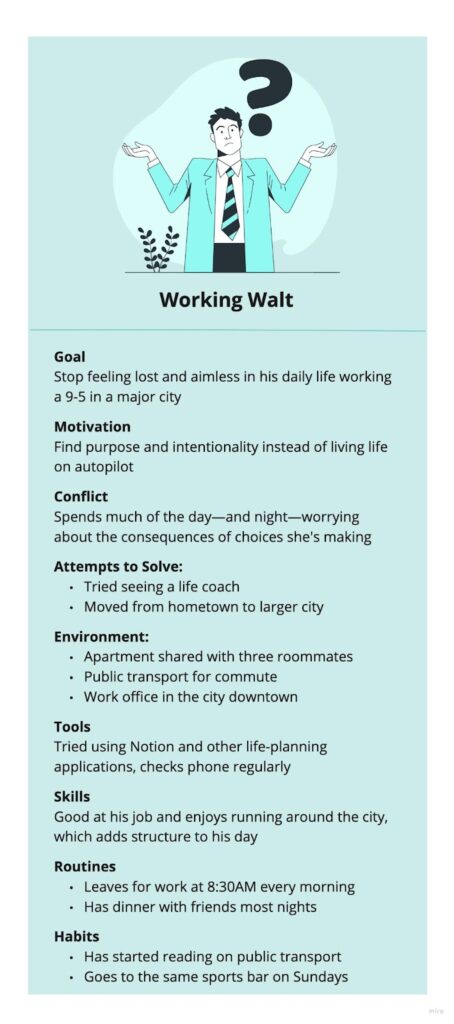
Walt’s journey map tracks his confidence level throughout the day:

These journey maps helped us identify when target users reset and evaluate their decisions: at the beginning of the day, during mealtimes, and when going to bed. This influenced our intervention study design. Furthermore, we realized that our personas struggled with significant changes to their initial plan for each day, which raises the question: how can we minimize this change, or make it more comfortable to experience?
Intervention/Product Ideation
Intervention Ideas
For more detailed descriptions of our intervention ideas, see here.
1. Focus on Positive Outcomes of Past Decisions
Aims to boost confidence and reduce regret by listing the benefits of past decisions. The motivation for this comes from our research, which indicates that confidence is a mindset, rather than a function of the decision itself.
Pros:
- Promotes a positive perspective
- Boosts confidence
Cons:
- Not suitable for people who have made harmful decisions
- Does not help make a “better” current decision
2. Use a Timer to Help with Making Decisions Faster
Nudge participants to use a timer during decision making to increase efficiency and overcome paralysis. This is motivated by our research synthesis showing that participants take too much time in decision making, especially for long-term decisions.
Pros:
- May force participants to act quickly and reduces indecision
- May help overcome analysis paralysis
Cons:
- May not allow enough time for careful reflection
- May not be suitable for high-stakes decisions
3. Reassessing Priorities During Two Checkpoints
Participants set priorities at the start of the day and reassess them at two checkpoints (lunch and dinner). Our research synthesis indicated that many participants struggled with choosing to be productive or to socialize.
Pros:
- Encourages prioritization and focus on important decisions
- Structured approach reduces stress and increases productivity
Cons:
- Not ideal for those with flexible schedules
- Possible demotivation if priorities are not completed by checkpoint
- Limited flexibility for unexpected events
Chosen Intervention
We chose Idea 3 because it addresses multiple challenges faced by participants: it provides a structured approach to time management, helping participants clearly set priorities throughout the day, making decisions easier. It also, like ideas 1 and 2, has the potential to help participants be faster and feel less regret because they are following the priorities they set.
We chose not to use idea 1 because it focuses on helping participants with decisions made in the past, and we chose not to use idea 2 because our synthesis found that making faster decisions was a less important problem than other ones.
Product Prototype
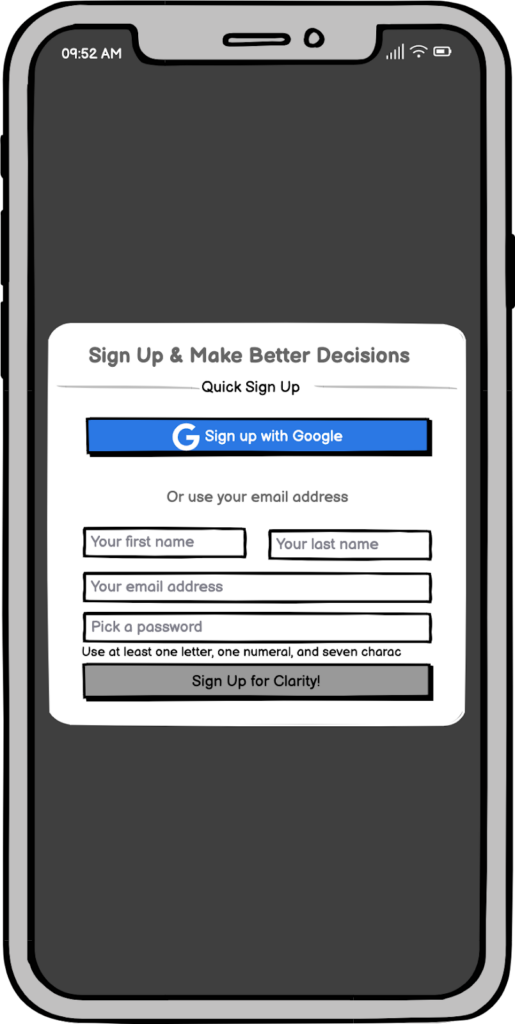
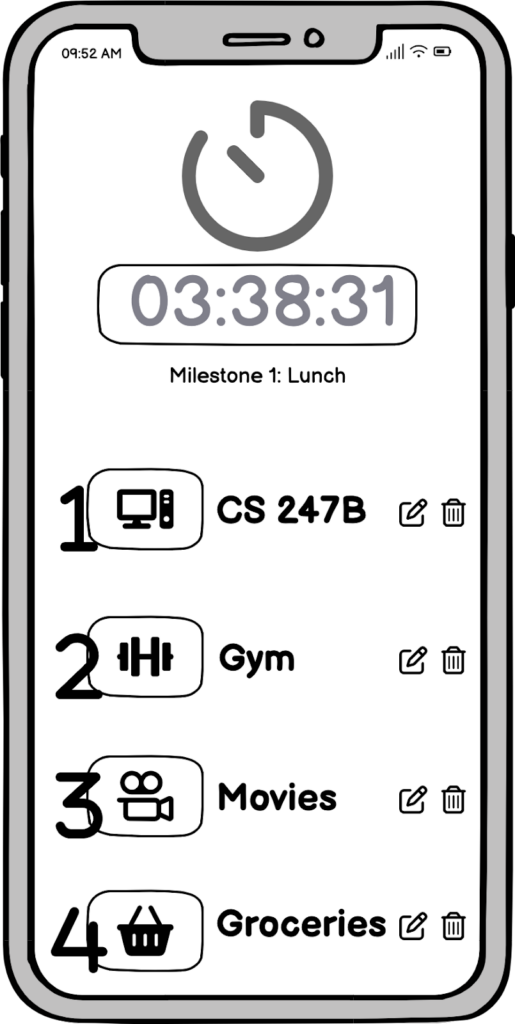

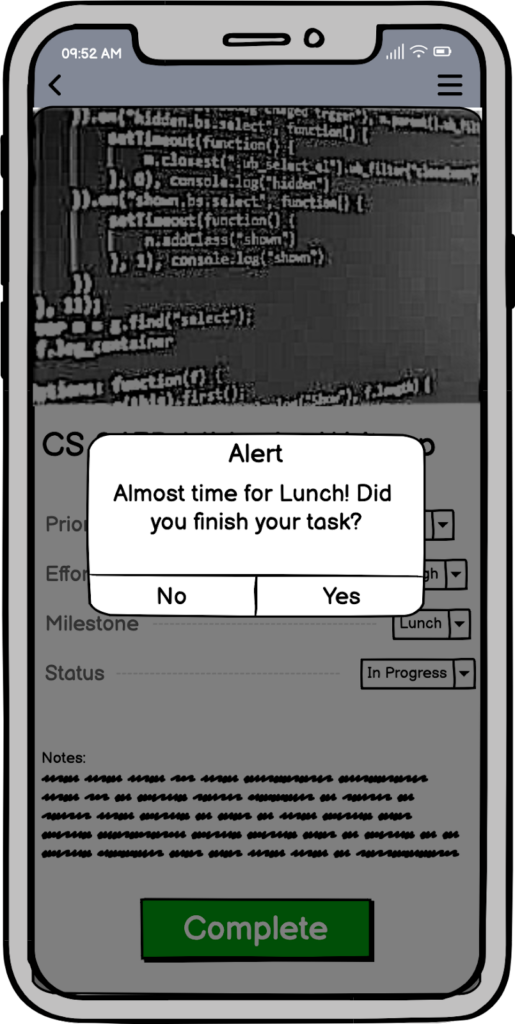
Mockup sketches of sign up page, glance view of decisions, full view of decisions, and alerts
Intervention Study
Protocol
We hypothesized that when participants explicitly listed their priorities, they would be more likely to make decisions that aligned with those priorities, and thus feel more confident during and after making decisions. We also investigated how positive reflection would make people feel about their decisions with question number 3 below, which asked participants to do exactly that. We guessed that focusing on positive impacts would increase participants’ confidence.
For our intervention study, we recruited 10 Stanford students who matched our target user profile: college students or recent grads who self-identify as indecisive. Of the 5 who completed the study, 2 of these participants also completed our baseline study. We asked participants to complete a daily log for 5 days, listing their top 3 priorities in the morning, at noon, and in the evening. At the end of each day, we asked participants to reflect on the following questions:
- How did your priorities change throughout the day? What caused those changes, if any?
- Did documenting your priorities affect how you thought about decision making? If yes, how so?
- What’s an example of a decision that you made that corresponded with a priority? What were the positive outcomes of this decision?
Synthesis
We followed a similar synthesis process as we did for our baseline study. We started with affinity mapping:


We found that many participants interpreted priority as current goals or to-dos. Although we left “priorities” open ended, we had expected that people’s priorities would be broad – e.g. “be more conscious about what I eat” – but instead we saw more literal priorities like “eat lunch”. A main takeaway here is that our solution will need to clarify this definition of priorities, either by providing some examples, or thinking of a better term. Otherwise, participants will be making to-do lists instead of tracking priorities.
Next, we did frequency mapping of our data:


The theme with the highest frequency was “What is priority?”, which echoed our previous findings that users had different definitions of priorities, which our solution will need to clarify. The next highest frequency was “Why prioritize?” which highlighted the benefits of writing out priorities that some participants noticed. Having explicitly stated what they wanted to work on, participants found it easier to remember these priorities when making decisions. One participant noted that “[documenting priorities] helped me remember to enjoy my day” after writing down “fun” as a priority. We also noted that every participant was able to list a positive outcome of one of their decisions from that day, indicating that this kind of positive reflection is a feasible future direction. Surprisingly, even when participants harped on the negative outcomes of their decisions in other parts of their reflection, they didn’t seem to regret it after their positive reflection: “I made the decision to go to my language class today instead of skipping. The positive was that I got dressed earlier and did not receive another absence in the class”.
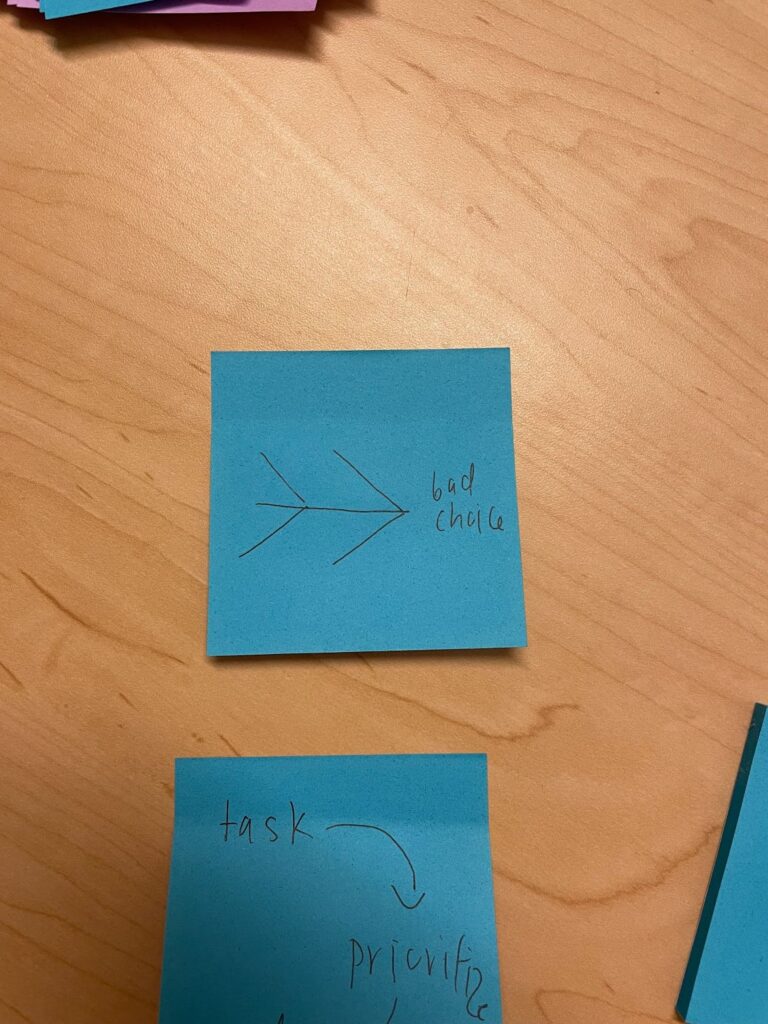
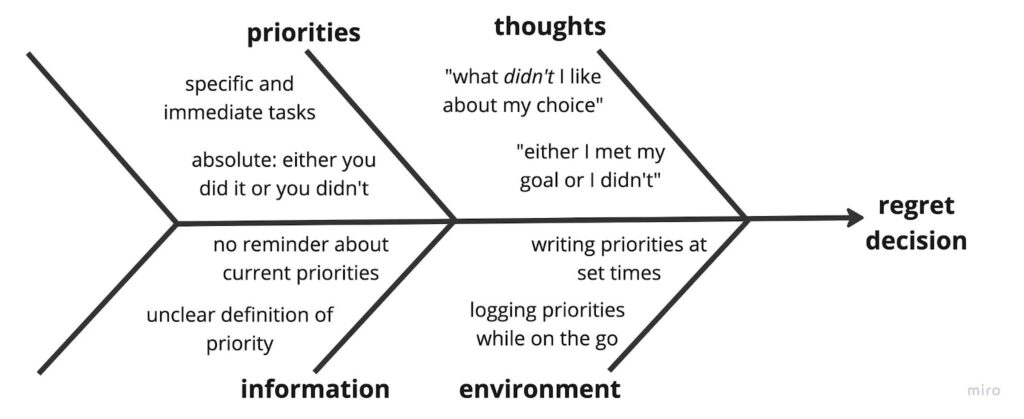

These diagrams helped us identify some areas to focus on as we develop our solution: 1) clarify our definition of “priority” so that users don’t turn the app into a to-do list, and 2) encourage positive reflection. Because both diagrams explored how participants came to regret their decisions, we need to figure out how our solution will interrupt these flows.
Storyboard & Stories
Our initial brainstorming from class can be found here.
Our storyboards converged on similar framings: post-grad life and the pressure of choosing the “right” lifestyle, and the short-term but seemingly high-impact decisions inherent to a single day in school. We diverged when choosing what our “wins” would look like: is our product social so users can broadcast their choices? Or would it “gamify” following your priorities? We decided to focus on individual user actions for our refined storyboards to nail down what would be the most helpful.

These storyboards explore the themes we noticed in class—confidence in making decisions, weighing multiple opinions, and positive reflection—and how our two personas would experience them. Each storyboard displays a possible direction for our product, and we imagine that our final solution would seamlessly combine these two (interrelated) missions of documenting priorities and highlighting how past decisions worked with respect to them.
What’s missing from our product panel is specificities on how our product will motivate users. In our intervention study, we used the existing pattern of mealtimes to cultivate a “tiny habit” of reassessing priorities, but our final product may need to equip design nudges to emulate this behavior.
Current Direction
Going forward, we will be trying to translate the successful parts of our intervention study—documenting priorities and positive reflection—into a mobile application or other relevant product. We need to experiment further with the best “nudge” design, be it inherent to our design or facilitated through notifications, that will make using our product more enjoyable than painful!
We would appreciate feedback on the best way to approach this initial design, as well as any further nuance we may have missed during synthesis.




Comments
Comments are closed.