
SYNTHESIS PROCESS
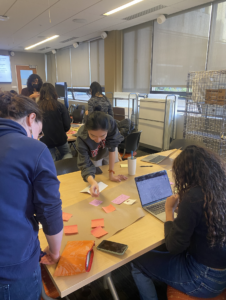
After our initial data collection process, we placed all of our findings on sticky notes and grouped them to find patterns among our data.
Technique 1: Affinity Grouping
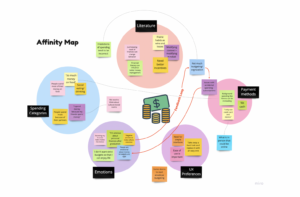
First we grouped the sticky notes based on their affinity. We all silently sorted the notes based on similarity, and slowing some big trend areas came about. The main categories we found were Literature, Spending Categories, Emotions, UX Preferences, Payment Methods.
Key Insights:
The affinity mapping unveiled several crucial aspects of our subject spending patterns. One of the most noteworthy findings is that a substantial portion of people’s expenditures is directed towards food. Furthermore, social influence is a powerful force that shapes spending decisions, as individuals often tend to follow the lead of their friends and partners. The role of peer pressure is often underestimated in its affecting spending habits.
We also found that emotions are a significant factor that impact spending, with feelings of anxiety and stress commonly arising from budgeting and at specific times of the year.
In light of these findings, it is crucial to emphasize that when it comes to budgeting, simplicity is a key factor in determining success. A straightforward and uncomplicated approach to budgeting can help individuals manage their finances effectively and avoid the stress associated with budgeting.
Inform Intervention Study:
From this technique, we realized that our intervention study should be as simple as possible. Many people commented that budgeting was too complicated, so we want to encourage them to do our study by making it attractively simple. We also could center our intervention study around food spending, for it seems that many people spend a majority of their funds in these categories.
Lastly, many people have strong emotions around spending, and this anxiousness could be something we center our study around. We could try to find ways to intervene with this negative emotion, and somehow turn it towards the positive.
Technique 2: 2×2
Next, we used an axis to sort these data points among important themes in our research. We chose to plot them from Simple to Elaborate, and Invasive to Non-Invasive.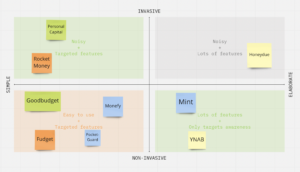
Key Insights:

From our 2×2 chart, we found that most of our related application centers towards the bottom left of the chart. This
section, Simple and NonInvasive, example applications, and would like to maintain their privacy when it is an option. The applications that are more invasive (such as Personal Capital) are more for those with a higher network, so might not be as applicable to our target audience.
Inform Intervention Study:
Similar to the last section, our 2×2 mapping has shown that in terms of money management… THE SIMPLER THE BETTER. People prefer a clear UX design, and limited features so that they can truly understand what the app is telling them to do with their money.
Technique 3: Story Mapping
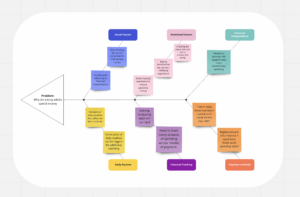
Lastly, we sorted our post in terms of what people said, thought, felt and did. From this, we were able to create a fishbone map showing all the factors that we believe influence a young adult to spend money.
Key Insights:
From our fishbone exercise, we were able to sort our data points into influence categories. From this, we found that the following factors strongly influenced young adults: Social, Emotional, Financial Independence, Daily Routine, Financial Tracking, Payment Methods. Social and emotional factors go hand-in-hand, as we found that young adults are likelier to spend money if they’re out having fun with friends, but these can also be separate from each other (for example, spending more money on a dinner than they would alone, or engaging in “retail therapy” by themselves). The other four factors are more helpful in guiding our model of the motivations that our target users might have as well as what might be successful in spurring a behavioral change.
Inform Intervention Study:
All of the factors we found above are important, so as long as our intervention study focuses on one of more of these factors, we are hitting part of young adult spending that is relevant. We are especially hoping to target social and emotional factors, such as accountability, as well as financial tracking that interrupts a daily routine, as these seem to have had a significant effect on financial awareness of our participants.
PROTO-PERSONAS + JOURNEY MAPS
Our target demographics from the beginning has been young adults, specifically those between the ages of 18 and 25. From our baseline studies, we were able to narrow down user profiles within that age group to 2 broad categories.
The first category was college students that were not entirely financially independent but were earning enough to support their discretionary spending. Pain points within this demographic often include the need to spend money on food and a general unawareness of spending until credit card bills needed to be paid as well as feelings of anxiety and heightened emotions surrounding money. Anxious Alice below captures the traits of users we observed in this group.
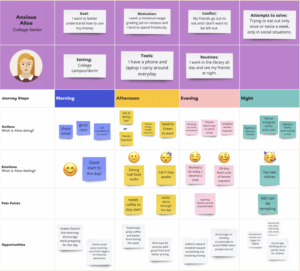
The second category was recent college grads who have recently started earning full-time salaries or are trying to navigate the professional world in some way. Pain points in this demographic encompassed more everyday issues such as commuting and impulsiveness influenced by financial independence. A day in Tired Tom’s life gives us a glimpse of major spending triggers for people in this group and we identify potential opportunities to address these triggers and pain points.
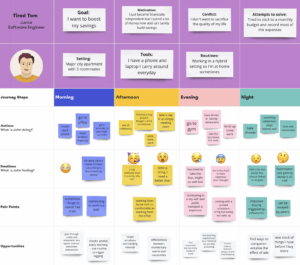
There were several insights we gained from these journey maps, specifically with regards to routines, pain points and opportunities. Some novel insights included:
- Ideas of celebration and ‘rewarding’ personal milestones often include spending in some way, typically with little financial limitation since people feel that they ‘deserve’ those rewards, further emphasizing the affect of emotions.
- Credit card statements, Venmo requests and other digital financial triggers are the typical milestone for an increase in awareness of ones’ financial standing. Self-motivated tracking is a lot more challenging to maintain.
- Hybrid work environments have shaken up traditional ideas of routine since there’s so much day-to-day variation. This change narrows the windows of time within which consistent routines can be leveraged to change behavior.
- Impulsiveness is a huge factor in one-off expenses, with ads, friends’ behaviors and social media influencers convincing people to spend ‘quick’ money that they wouldn’t have spent if they sat on the idea for a few hours.
INTERVENTION IDEA
While ideating for interventions and effective ways of tackling the financial accountability problem, we were trying to target two primary pain points that we learned of from the baseline study and journey maps:: 1) making the accountability aspect of budgeting and financial tracking more fun, reducing negative emotions associated with it while still increasing awareness and 2) keeping the system simple and accessible without overloading the user with numbers. We also wanted to keep in mind existing apps that help with budgeting and financial tracking and wanted to ensure that we were filling in the gaps in those systems with out prototype. Some of the ideas we deliberated include:
1.Gamified Budgeting
- Method: Use participant reports of their daily financial habits and goals that we have them set the previous day to simulate a simple game and construct their progress on the game as a product of their financial habits. We ask for their progress at 12 hour intervals and send them a message with their position in the game.
- Motivation: We are inspired by a focus App called Forest where it lets the users “plant a tree” whenever they want to stay focused, and the tree will grow while the users focus on work, while leaving the App halfway will cause the tree to die. We are considering letting the users raise a virtual pet or grow a tree on our app, and as long as they track expenses on our app on a daily basis, the pet/tree will be healthy.
- Pros: Builds on empathy and ideas similar to WhoIsZuki to make users empathize with game characters and work towards goals that sound simpler.
-
-
- A major problem for budgeting apps is attrition and this gamification process will likely provide additional incentive for retention.
- Makes budgeting accessible and simple for people across ages, cultures, genders and more. This method addresses the need for simplicity in managing finances.
-
- Cons:
-
- Complicated to implement, will probably need a great deal of hashing out the narrative, managing ethical considerations and ensuring that the story reflects spending effectively.
- This method targets a superimposed solution instead of the root problem which might lead to unsustainable habit modification.
2. Simple, moderately intrusive reminders of personal goals
-
- Method: Send the participant reminders at infrequent intervals of their budgets for specific categories for the day and then records how those goals were met at the end of the day.
- Motivation: This intervention builds on ideas we discovered in the literature review that indicate awareness and just being alerted to your spending habits can be effective in altering them.
- Pros: Simple to implement at a micro and macro level
- Fairly un-intrusive, does not collect any information from the user, simply makes sure they are aware of their own goals.
- Cons: Does not track awareness – only real data will come from periodic surveys, etc
3. Buy yourself a bag of candy, every-time you make a purchase, log it, and then eat a candy
-
- Method: Each participant has a bag of candy from which they eat a candy each time they spend money and remember to log the expenditure.
- Motivation: This intervention simply builds on Pavlovian ideas of rewarding a behavior you want to be repeated as well as findings that suggest that nudging in the form of increasing awareness is effective in changing behavior.
- Pros: Simple, high likelihood that people will give it a shot
-
-
- Builds on psychological research on behavioral change across fields of study
- Frames spending as wins and losses which is also an effective method
-
- Cons: May be too simple – how to track real change? Also may inadvertently track how often people log things, rather than tracking their awareness.
In order to narrow down the system we wanted to test, we took into consideration our own capabilities as developers of this system and the users’ experiences as long term users of the system. We mapped the ideated systems on the 2×2 above according to ease of prototyping and whether or not the system was sustainable long-term.
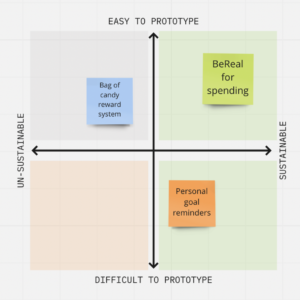
Thinking about gamification and its issues with sustainability, we were able to rethink that system to more closely resemble BeReal – as a platform that is fun and encourages accountability but is not majorly intrusive or overwhelming. Based on this, we were able to identify ‘BeReal for budgeting’ as a sustainable, easy to prototype system tackles both the major pain points we were attempting to mitigate. BeReal since its inception has achieved a surprisingly sustainable was of making people perform a certain action once a day and we’re seeking to emulate that behavior without bothering the user at regular intervals in a week. The goal is to simple make them aware of each expenditure in the day and ensure that they have visibility of past expenditures and tier timestamps to understand how and when they are spending.
INTERVENTION STUDY
Based on our findings in the synthesis process, we came to a consensus on the first intervention idea and decided to conduct study that is somewhat “be real” for spending. Anytime you make a purchase, take a selfie. In this selfie, express how you feel about this purchase. If it was unneeded, maybe a sad face, if it was something you have been saving for, maybe a super happy face. We will have our participants send these photos to us, and at the end of each day we will remind them to send all photos and ask if they forgot anything.
This study idea matches our research findings for it is 1) simple and 2) adds some gamification to the financial literacy space.




Comments
Comments are closed.