Team 10 (Geckos) Norms
- Direct communication, be transparent
- Tell the team early if you need help
- Air out your concerns early
- Be proactive about scheduling around a busy week of work. If your capacity changes, communicate clearly and early
- Respond within 6 hours
- Value alignment
- Make sure that we all agree on the vision of the project
- Plan and communicate the underlying goals and values of the project in advance
- Aim for an end goal of a product that we can all be proud of
- We are proactive about deadlines
- Work on not blocking other people’s to-dos where possible (if part A needs to be done before part B, be proactive!)
- Communicate each person’s task, being clear about who does what
- Commit to doing what you say you’re going to do
- Be timely
- Things happen, but be on time to team meetings
- Make use of the time we have together
Interview Screener
- Are you 18 years of age or older? (Yes / No / Prefer not to answer)
- Are you comfortable participating in a research interview conducted in English? (Yes / No)
- Which option best describes your current professional role? (Product Manager / Product Lead / Director or Head of Product / Project Manager / Technical Project Manager / Chief Product Officer / Other product-related role / Not currently working in product management)
- How many years of professional product management experience do you have? (Less than 1 year / 1–2 years / 3–5 years / 6–10 years / More than 10 years)
Our New Interview Questions
- Can you tell me about your PM experience, your work, and who you are?
- Can you give an overview of how you got into product management?
- How did you get into this role?
- Who do you spend most of your time collaborating with?
- Where do you get the most human connection at work?
- Tell me about a time when you felt connected to your team.
- What does the day-to-day life of a product manager look like?
- Could you walk me through a typical day?
- A good day?
- A bad day?
- How do you split your week?
- When did work last feel great, and what made it feel great?
- What are the biggest points of friction or downsides of being a product manager?
- What is something you do every week that you wish you didn’t have to do?
- What traits make someone a good product manager?
- Which traits help you do well at your job?
- What decisions are you responsible for?
- What takes up your mental energy?
- How do you make decisions?
- How do you view prioritization?
- How much autonomy does a product manager have at [COMPANY]?
- Tell me about the last decision you made without needing anyone’s sign-off.
- Tell me about the last time you needed someone else’s approval. What happened?
- How do you perceive your role as a PM within the company?
- How closely do you collaborate with the engineering and design teams? Why?
- Tell me about the last time you and engineering or design disagreed. What happened next?
- Who decides which tools your team uses?
- Tell me about the last time a tool decision came up. What role did you play?
- Tell me about a time where you’ve seen AI impact the role of a Product Manager.
- Tell me about a time when you used AI in a product-management workflow.
- Tell me about a time AI didn’t help, and you had to do it yourself.
- What advice would you give someone interested in becoming a PM?
- Is there anything important about product management that we did not discuss?
Affinity Map
The Miro board can be accessed here.
Procedure
- We began by typing our key insights and notes into the Miro board, color coded per person.
- Then, we jotted down thematic concepts and grouped the sticky notes to find common themes and recurring topics.
- We present the affinity groupings below and explain our reasoning.
Affinity Groupings
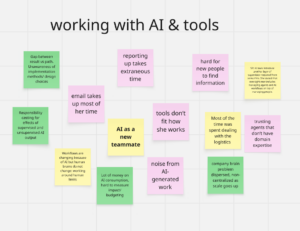
Working with AI & tools. What happens when AI becomes part of the workflow? Many comments here were about AI as a new teammate. PMs now manage agents on top of people, deal with noise from AI-generated work, and have to decide when to trust an agent that doesn’t have domain expertise. Some also raised newer problems: who’s responsible for AI output, not knowing how the AI got to its result, and AI costs that are hard to measure. We also grouped in the everyday overhead, like reporting up, email, logistics, scattered company knowledge, and tools that don’t fit, since that’s the work people hoped AI would take off their plate.
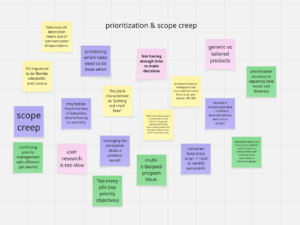
Prioritization & scope creep. Many PMs talked about having more on their plate than they have time for. Vague job descriptions let scope creep in, and AI has raised expectations to do more with the same time and people. Across teams and pods, priorities conflict and there are “too many P0s,” so urgent work crowds out long-term fixes like automation. The job came across as “putting out small fires,” with PMs feeling like the face of everything without any real authority.
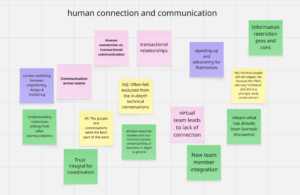
Human connection and communication. PMs said the people and conversations were the best part of the job, but a lot of communication still feels transactional, especially on virtual teams and across engineering, design, and marketing. Trust came up as the foundation of coordination, along with the work of bringing new team members up to speed and understanding the limits other teams are working under. Early-career PMs felt the disconnect the most. They described having to advocate for themselves and not always being respected or included in technical conversations.
Affinity Grouping Screenshots
Working with AI & tools
Prioritization & scope creep
Human connection and communication
AI Pass
Interviewees are anonymized as I1–I16.
| # | Cluster | Who | Hurts? | Hacks they already use |
|---|---|---|---|---|
| 1 | Mechanical coordination and communication overhead (reporting up, batch email, repeat questions, status updates, knowing who needs to know) | I4, I3, I10, I5, I11, I1, I2, I7, I13, I16 (10) | High. I4: “stinks,” “sucks”; I3 and I2 both named reporting up or justifying work as their weekly pain | I10 wrote scripts for Slack channels and assignments. I5 turns repeat questions into process fixes. I4 does it by hand. I3 wants AI to draft 80% of reports. I13 ends every check-in with clear owners and next steps. |
| 2 | No time to think: reactive days, micro-decisions, meeting overload | I1, I2, I7, I4, I11, I10, I8, I14 (8) | High. I1 is now “a day ahead at best” (it used to be 6–12 weeks) and works nights and weekends | Meeting-free Fridays, “meetings with myself,” canceling meetings with no agenda, front-loading meetings on Mon/Tue |
| 3 | AI volume and speed outrunning human review (PR floods, bloated writing, overconfident LLM output, pressure to ship faster) | I8, I9, I1, I2, I5, I3, I11, I14 (8) | High. I5 calls it his “biggest pain point,” and I9 says engineers and PMs are “taking the heat” | I9 cuts his writing to a couple of sentences. I5 gets AI context before pinging engineers. I11 insists on human-written communication. I14 says up front what a launch can’t do yet rather than shipping something underbaked. No fix for review load. |
| 4 | Prioritization, scope creep, vague direction | I6, I8, I9, I2, I1, I10, I14, I15, I16 (9) | Medium-high. I2 struggles with it “all the time” | “Three things we’re NOT doing,” “don’t chase perfection,” data to defend trade-offs. Mostly mental rules, not tools. I16 ranks requests by the business impact of the blocked workflow. I14 looks for patterns to decide platform feature vs. one-off. I15’s team rotates engineers through bug duty so reactive work doesn’t interrupt projects. |
| 5 | Accountability without authority (stakeholder management, credibility, being the face of failures) | I6, I7, I8, I9, I12, I13, I14 (7) | Medium. This is the emotional core of the “bad day” answers | Relationship building, 1:1s with leads, bringing data to leadership. I13 escalates trade-offs with the options and consequences laid out. |
| 6 | Organization slower than the tools (slow strategic decisions, silos, matrix approvals) | I2, I3, I1 (3) | High but not mine to fix | Mostly none. I2 pushes back and tries to speed up correction. |
| 7 | Access to users is slow (research logistics, finding participants, sponsors) | I3, I4, I8, I2 (4) | Medium | One company’s research team builds its own tooling (per I3). Otherwise manual. |
| 8 | Unforeseen tool limits | I10, I4 (2) | Medium | I10 switched from Replit to Lovable. I4 accepts the Word → Box → download loop. |
| 9 | What works on paper breaks in real use (benchmarks vs. real traffic, “optimal” schedules users reject, designs that fall apart with real customer cases) | I10, I13, I14, I15, I16 (5) | High | Preparing in parallel while blocked, internal testing before customers see it, continuous testing in production |
Comparing AI to Human Affinity Diagramming
AI was better at data access, giving clearer citations and a sense of who said what. It also surfaced some blind spots through sheer quantity: compared to our 3 key themes, it produced 9. However, these themes were less developed. “Access to users is slow,” for example, is a smaller complaint rather than a broad theme, and “AI volume” and “unforeseen tool limits” were sub-themes that we combined into a single larger theme. We focused on synthesis and condensing the themes, whereas the AI focused on brainstorming as many as possible. While both quality and quantity are valuable in brainstorming, the AI ideas mostly verified our topic coverage and reorganized existing content, though it did surface one major theme we missed.
What it caught that we missed: The AI’s biggest cluster, communication overhead (reporting up, status updates, finding who needs to know), raised by 10 of 16 people, wasn’t one of our three themes. AI is helpful as it has access to all data simultaneously to draw missed connections.
What it flattened: It put very different problems into one bucket. For example, a project manager’s sponsor outreach ended up under “access to users is slow” with PMs who can’t reach customers. It also folded early-career PMs’ credibility problems into a general “accountability without authority” theme, which is very different from how we grouped things.
What it asserted that isn’t in the transcripts: Its “Hurts?” ratings (High, Medium) are its own guesses, based on how strongly people worded things; nobody rated their pain in any formal way (e.g., a Likert scale or percentage). It also put some people in clusters they barely touched. For example, it listed I1 under prioritization and scope creep, but he never discussed either explicitly. And “High but not mine to fix” is the AI’s opinion rather than something an interviewee said.
Long List
Counts are out of 16 interviewees.
- AI as a new teammate: PMs are struggling with what to hand to AI, what to review themselves, and how AI pushes their productivity. (9 people) “The number of PRs that are open now is so much larger.”
- Scope creep and prioritization: PMs need clear boundaries, but vague requests quietly inflate their workload. (8 people) “You plan to do something… and then you just run into a bunch of roadblocks… and adds a ton of work to your plate.”
- Accessing human connection: PMs need more time with real people to better identify pain points and improve communication with different stakeholders. (5 people) “A lot of the time it takes to do user research actually has to do with coordinating and getting the right participants.”
- Decision making is either too slow or too fast: It often feels like PMs have to make an in-the-moment decision, or it is made for them by upper management and now they have to execute. (5 people) “Really lots and lots and lots of micro decisions just flying at me.”
- No authority: PMs are usually the face of the product, despite having no control or authority over anyone who works directly on the product. (8 people) “Even with all the influence and impact and us pushing through… there are certain things I don’t own.”
- Finding context: Usually, a PM’s job starts from scratch. They research the market, the product, and the competitive landscape before thinking about execution. A tool that can help PMs find that context reliably could make their job easier. (4 people) “Where the hell do I look to get this information?”
- Identity as a PM: Some PMs found it difficult to feel respected and included in a role that requires supervision and oversight while being younger, early-career, or less technical. How might we make it easier for people to push past perceived barriers and professionally develop? (2–3 people) “I needed to have a level of seniority prior to coming in, in order for me to be taken seriously.”
- Lack of personalization and customization of tools: PMs need to consistently adapt to new circumstances and roles, but some feel that existing tools do not work well for them, or that they are stuck in workflows that do not support their own decision-making. (4 people) “All the email tech that never quite works well enough.”
- Communication overhead: PMs spend a lot of time keeping everyone in the loop, through reporting up, status updates, and figuring out who even needs to know. (8 people) “You don’t necessarily know who needs to know what’s going on, you have to go find those people.”
- Works in theory but breaks in practice: Plans, benchmarks, and designs look fine until they meet real customers, real traffic, or real suppliers, and then the team has to rework them. (5 people) “There were just, like, a bunch of complications involved in that, that were just completely unforeseen.”
TAM
Number of PMs: about 1.6 million worldwide. A 2023 study of LinkedIn’s Product Management job category counted 1.618M PMs, including 427k in the US and 567k in Europe (Product Focus, 2023). This is most likely an undercount, since LinkedIn isn’t widely used in some countries and PM or PM-adjacent roles can go by many job titles.
Spend per PM: about $600 per year on PM-specific tools like roadmapping, feedback, and planning software, based on typical per-seat pricing (Crozdesk).
TAM (bottom-up): 1,618,000 PMs × $600/year ≈ $970M per year
Top-down check: Market reports put the product management software market anywhere from $1.3B for roadmapping tools only (Spherical Insights) to $6.6B for broader product management software (ReportPrime) in 2025. Our estimate is close to the narrow, PM-specific number, which makes sense since broader product management software is also used by engineers, designers, and other teams, not just PMs.
Comparing Cold & Round 2
Our cold interviews leaned on broad questions about a typical day and on opinion questions about what makes a good PM, what advice they’d give, and where the role is going. The answers were general statements about product management, not evidence about the person’s own work. When we asked about AI, people predicted the future instead of describing what they do now. Our strongest round-1 moments came when we asked for a specific example, so we used that result to shape how we approached round 2. In round 2, we asked about specific moments: the last time work felt great, the last time it went badly, and the tasks people wish they didn’t have to do each week. The answers were consistently stories about real events, with real people, tools, and outcomes. When we asked about AI, we asked how people use it today instead of where it’s headed. That got us evidence about how their work has already changed, plus the workarounds some of them have started using.
Several PMs described one thing and did another. One said he protects focus time with meeting-free Fridays, but he actually catches up by working nights and weekends. A project manager said there’s “nothing really to fix” in her Word / Box / download workflow, then described it as one of her most frustrating weekly tasks. A few PMs said they don’t have bad days, but they described stakeholder pressure and missed deadlines. What people did and told us about in their stories was often the clearest signal: writing scripts to automate Slack admin, cutting their writing to two paragraphs, and tracking to-dos in rudimentary notes.
We expected AI to save PMs time, but most described it as adding work with more output to review, higher expectations, and noisier communication. Decision speed also cut both ways. Some PMs said they’re forced to decide too fast, while others said their organization decides too slowly. Sometimes the same person said both, depending on who owned the decision.
Access to users depended on the company. PMs at lean, technical companies talked to customers constantly, while PMs at larger companies struggled to reach them. One PM also said prioritization would be easier if more of the requests were bad ideas. It’s only hard because they’re choosing between good ones.
Reading
We used this week’s reading in a couple of ways. First, we screened all of our interview questions against the three-part criteria outlined in the article: open-ended, not leading, not about the future. Second, we added more questions that prompt our interviewees to tell us a story. Instead of asking “How do you think AI will impact the role of a PM in the future?” we asked “Tell me about a time where you’ve seen AI impact the role of a Product Manager.” This empowers our interviewees to tell us a true story about their lives without asking them to conjecture or guess how to quantify their own experiences.
Google Drive
The Week 2 Milestone folder of our Google Drive can be accessed here.